
Opens the download page on distrib.wiki.
English edition published on .
Bodhi Linux: a lightweight, customisable distribution
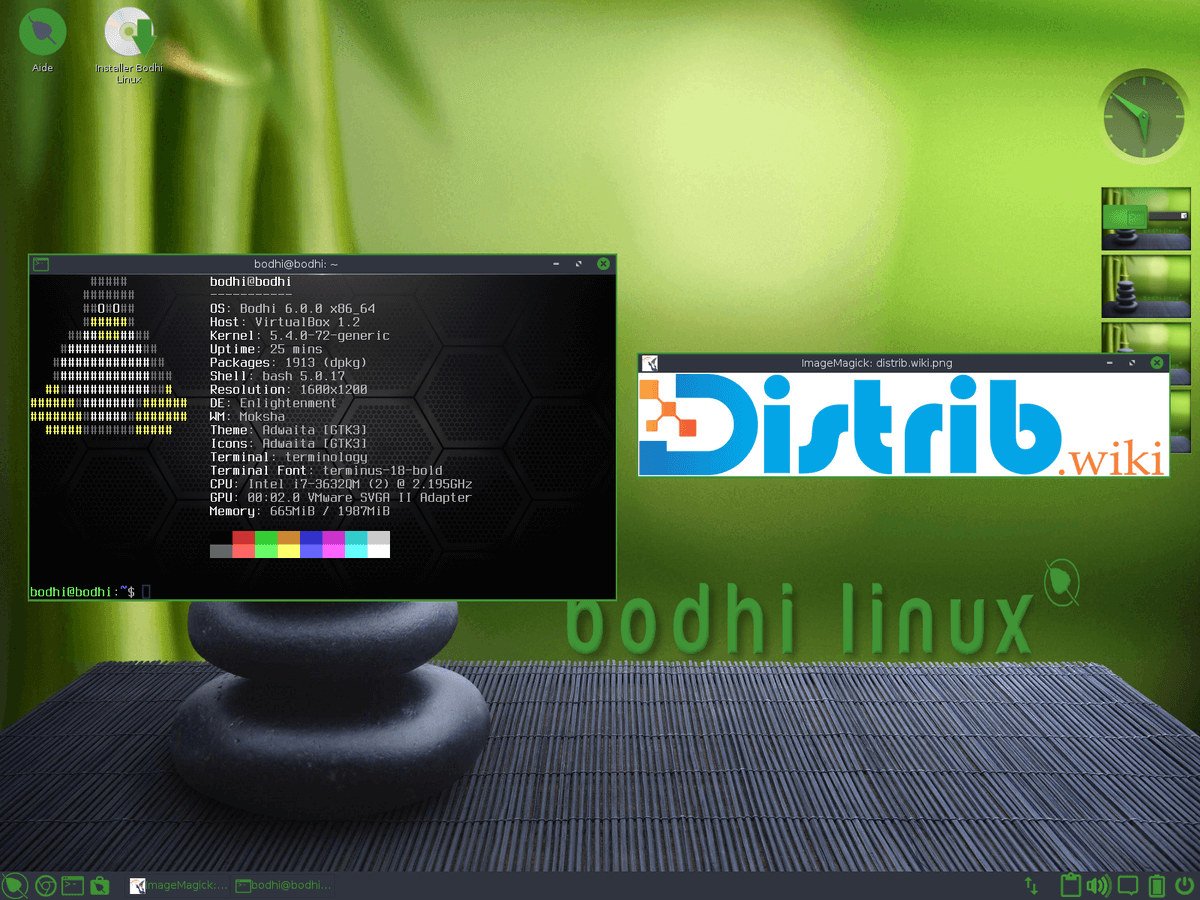
Bodhi Linux is a free, open-source distribution designed around a responsive, minimal and customisable desktop. Based on Ubuntu, it is distinguished by Moksha Desktop, derived from Enlightenment and focused on a small footprint and extensive configuration.
Rather than installing a large application collection by default, Bodhi supplies a minimal base. Users add the applications they actually need, keeping their environment as restrained or as extensive as they choose.
It particularly appeals to users of modest or older computers, people seeking an alternative to GNOME, KDE or Xfce, and those who prefer building their environment gradually. Its Ubuntu foundation provides access to a broad software ecosystem and hardware-support resources.
History of Bodhi Linux
Bodhi Linux launched in 2011 as a lightweight distribution centred on Enlightenment. While many desktop distributions were growing more resource-intensive, Bodhi chose to supply a minimal base and let users select their applications.
The desktop became a defining feature. Bodhi initially used Enlightenment, then developed Moksha as a fork of Enlightenment 17 to retain an interface consistent with its lightweight philosophy. Moksha remains central to the distribution’s identity.
Bodhi has followed Ubuntu LTS bases to combine a long-lived foundation with a distinctive desktop. The original profile discusses Bodhi Linux 7.0.0, based on Ubuntu 22.04 LTS according to its release announcement; check the project website for newer releases.
Bodhi occupies a specialised place in Linux: it does not aim to include everything at installation, instead offering a clean, configurable base for users who want control over their setup.
Advantages of Bodhi Linux
Moksha and a minimal default installation keep desktop resource demands low. This can suit older computers, modest laptops, virtual machines and users seeking a restrained environment.
Moksha offers extensive customisation of appearance, modules, themes, panels, virtual desktops and interface behaviour. Users can adapt the desktop closely to their working habits.
The Ubuntu base provides repositories, compatibility with many applications, security updates for supported components and substantial documentation. Many Ubuntu solutions also apply, though Bodhi-specific differences should be checked.
The image variants described in this profile address different needs: Standard for ordinary 64-bit installations, HWE for newer hardware support, s76 for certain System76-related requirements and AppPack for a larger preinstalled application set.
Its minimal approach suits users who dislike crowded default installations. They can choose their browser, office suite, media tools and development applications instead of accepting a large predefined collection.
Limitations of Bodhi Linux
Minimalism also means additional setup. Users may need to install several essential applications themselves. Those who want a complete first-boot environment may find Linux Mint, Ubuntu, Zorin OS or MX Linux more convenient.
Moksha’s organisation, menus, modules and configuration model can take time to learn. Users coming from Windows, GNOME, KDE Plasma or Xfce may find its approach unfamiliar.
Bodhi’s community is smaller than those of Ubuntu, Debian, Fedora and Linux Mint. Highly specific tutorials can be harder to find, although Ubuntu documentation often helps.
An Ubuntu LTS base prioritises a stable platform over the newest packages. Recent application or driver versions may require another supported packaging method or a variant with a newer kernel. Additional repositories must be considered carefully.
Bodhi mainly targets lightweight desktops and learning or hardware reuse. It is not primarily intended for production servers, cloud infrastructure or complex enterprise environments.
Bodhi Linux editions
Standard Edition provides the principal minimal 64-bit setup with Moksha. It suits users who want to install a lean system and add their own applications.
HWE, short for Hardware Enablement, targets newer computers. Its newer kernel is intended to improve support for some recent processors, graphics cards, Wi-Fi devices and other components compared with the Standard image.
The s76 edition described by the project targets System76 hardware and users needing its newer kernel and components. Its suitability depends on the particular machine and release.
AppPack includes more applications from the start. It is less minimal than Standard but can provide a usable everyday setup sooner for people who prefer common software already installed.
Legacy Edition serves older 32-bit computers, including some non-PAE processors. The original profile identifies the separate Bodhi 5.1.0 image, approximately 747 MB, rather than a 32-bit edition of 7.0.0. This is an older generation: verify its support status before considering any connected use.
Overall assessment
Bodhi offers a distinctive, lightweight and customisable desktop through Moksha, an Ubuntu base and minimal defaults. It appeals to users who want a restrained environment they can shape themselves.
It may not suit people expecting a fully equipped system immediately after installation. For users who enjoy building their environment gradually or want to explore Moksha on suitable hardware, it is worth testing.