
Opens the download page on distrib.wiki.
English edition published on .
Netrunner: Debian-based Linux with KDE Plasma
Netrunner is a free, open-source GNU/Linux desktop distribution based on Debian Stable and using KDE Plasma. It aims to provide a complete, preconfigured environment with applications for everyday tasks.
It targets users who value Debian’s stable base but prefer a more customised desktop from the start. Unlike a minimal Debian installation, it supplies a configured Plasma environment and common applications for the internet, office work, media, creative tasks and files.
The focus is personal desktops and laptops. Debian Stable provides a base that favours consistency over continuous change, while selected components may be newer depending on the release.
The history of Netrunner
Netrunner launched in 2010. Early versions belonged to the Ubuntu and Kubuntu ecosystem and aimed to provide a fuller KDE desktop experience. The project later moved towards Debian for a more stable, consistent base.
Over time it offered Kubuntu-based versions, Debian Testing versions and then a stronger focus on Debian Stable. Its main identity became a preconfigured Debian desktop with KDE Plasma.
A Rolling edition based on Manjaro and Arch also existed, but that branch was discontinued. The project subsequently focused on its Debian Stable Desktop edition and images for selected ARM hardware.
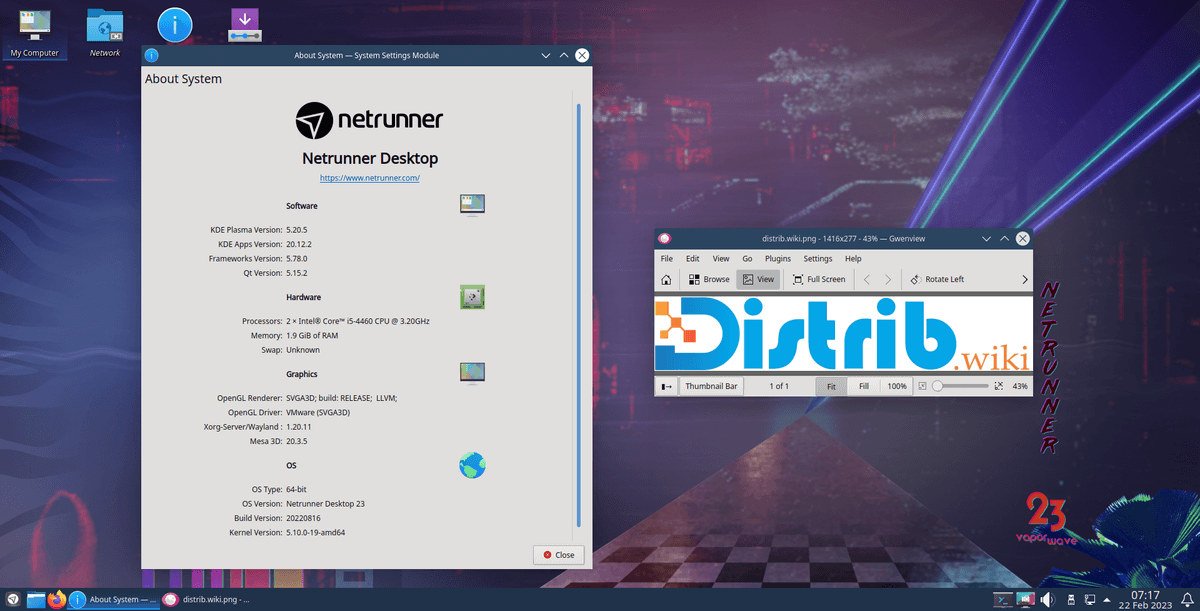
Netrunner 26 “Twilight” was released on 2 April 2026. The release described in the French profile uses Debian Stable 13 “Trixie”, KDE Plasma 6.3.6 and Linux kernel 6.16, marking a move to Debian 13 and Plasma 6.
Advantages of Netrunner
The Debian Stable base provides an established package ecosystem and a system with fewer abrupt changes than many rolling-release alternatives. That can be useful for everyday computing.
Plasma is preconfigured and accompanied by suitable applications. Users can still customise panels, menus, themes, widgets, shortcuts and desktop organisation.
The ready-to-use application selection includes a browser, office tools, media applications and KDE software. This reduces the amount of manual setup needed for a functional desktop.
Netrunner also offers an alternative to a more restrained standard Debian KDE installation, adding visual customisation, settings and software choices intended to make the environment approachable.
The ISO supports a live trial followed by installation. The official download page supplies practical details such as image size, Debian base and the credentials used in the live environment.
Limitations of Netrunner
Its smaller user base can make recent project-specific tutorials and troubleshooting guidance harder to find than for Ubuntu, Debian, Fedora, Linux Mint or Arch Linux.
Debian Stable repositories do not always provide the newest applications. Users who prioritise recent versions may prefer Fedora, Arch Linux, EndeavourOS or openSUSE Tumbleweed.
Plasma’s many settings, widgets and options can overwhelm someone seeking a very minimal interface, even though they offer flexibility to experienced users.
Netrunner is less broad in scope than Debian itself. Debian supports many desktop choices and specialised configurations; Netrunner mainly targets a preconfigured Plasma desktop.
The project is primarily for desktop use and learning. For production servers or business infrastructure, assess alternatives such as Debian Server, Ubuntu Server, Rocky Linux or Red Hat Enterprise Linux.
Netrunner releases and editions
Desktop is the main edition for personal computers. The Netrunner 26 “Twilight” image described here is a 64-bit ISO of approximately 3.4 GB, based on Debian Stable 13 “Trixie” and Plasma 6.3.6.
Netrunner Core was a reduced edition with fewer applications above the Plasma desktop. It addressed users seeking a lighter starting point while retaining Netrunner’s KDE identity.
The official site has also offered ARM images for selected hardware, including Pinebook and Odroid. These differ from standard PC images; verify current support for the exact device.
The former Manjaro/Arch-based Rolling edition is no longer the project’s main direction. Users specifically seeking rolling updates with Plasma can compare Manjaro KDE, EndeavourOS with KDE and Arch Linux with Plasma.
For an initial installation, start with the Desktop release offered on the official download page. Netrunner 26 “Twilight”, based on Debian 13, is the release covered by this profile.
Conclusion
Netrunner combines Debian Stable with a preconfigured KDE Plasma desktop. It offers a balance of a stable base, desktop customisation and an included application selection.
Its community is smaller than those of the largest distributions, but its approach may appeal to people who want Debian and Plasma with configuration already prepared for personal or workstation use.