

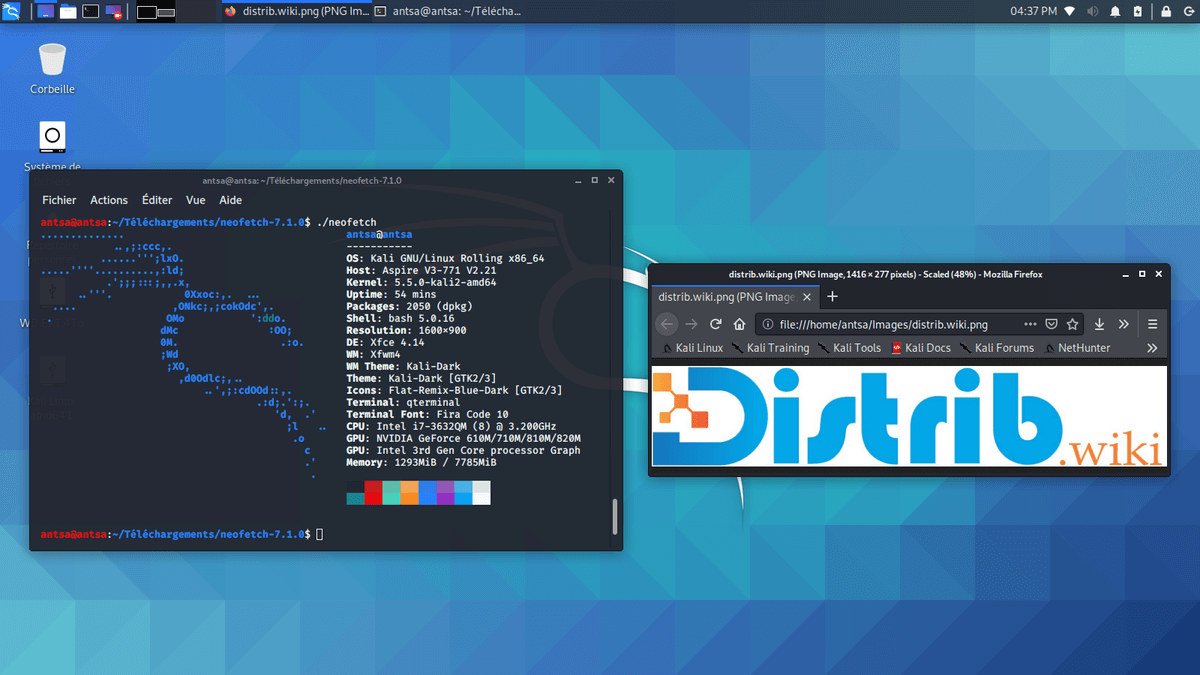
Opens the download page on distrib.wiki.
English edition published on .
Kali Linux: a Linux distribution for cybersecurity
Kali Linux is a free, open-source, Debian-based Linux distribution designed for cybersecurity professionals. It is used for penetration testing, security auditing, digital forensics, security research, reverse engineering, vulnerability management and Red Team exercises. Unlike general-purpose distributions such as Ubuntu, Fedora or Linux Mint, its primary purpose is to provide a specialised security platform rather than a conventional desktop system.
Kali Linux is developed and maintained by Offensive Security. It includes many ready-to-use security tools, including Nmap, Wireshark, Metasploit Framework, Burp Suite, Aircrack-ng, John the Ripper, Hydra, sqlmap and Maltego. They cover reconnaissance, network analysis, web testing, wireless auditing, forensics, exploitation, post-exploitation and reporting.
Kali Linux is intended for lawful, professional and controlled use. Use it in authorised environments: test laboratories, training, internal audits, challenge platforms, your own machines or cybersecurity engagements with explicit permission. Its purpose is to help assess and strengthen systems, not to carry out unauthorised activity.
The history of Kali Linux
Kali Linux succeeded BackTrack, a distribution widely used in computer security that already bundled numerous penetration-testing and auditing tools. In 2013, Offensive Security replaced BackTrack with Kali Linux, introducing a stronger base, better package organisation and more structured maintenance.
The transition was significant. Building Kali on Debian provided a robust packaging system, improved stability and cleaner integration. This reinforced its role in training, cybersecurity laboratories and auditing environments.
Since 2016, Kali Linux has followed a rolling-release model. The installed system receives regular updates without needing a complete reinstallation for each major release. Periodically published images provide recent installation starting points, while installed systems continue to evolve through updates.
Kali Linux 2026.1 was released on 24 March 2026. As the first Kali Rolling release of that year, it brought a visual refresh, a BackTrack mode for Kali Undercover and several new tools. Kali continues to evolve within the cybersecurity ecosystem.
Advantages of Kali Linux
Its first advantage is specialisation. Kali gathers tools for auditing, penetration testing, network analysis, digital investigation and security research in one environment. Security professionals can quickly obtain a comprehensive, consistent platform for technical work.
Kali can also save setup time. Security tools can be installed on other Linux distributions, but users must find them, configure them and manage dependencies. Much of that preparation is already done in Kali, allowing practitioners to focus on their analysis.
Another strength is platform choice. Kali can run on bare metal, from a live USB drive, in a virtual machine, through WSL on Windows, in the cloud, in containers or on supported ARM devices. Kali NetHunter also provides an Android-based mobile penetration-testing platform.
The distribution has extensive documentation and an active community. Official guides cover downloading and verifying images, preparing USB media, installing, using virtual machines and customising ISO images. This documentation is essential for using such a specialised system correctly.
Kali can also support supervised cybersecurity learning. In a personal laboratory, with deliberately vulnerable machines or as part of training, it provides access to auditing methods, reconnaissance tools, network analysis, web testing and security practices.
Limitations of Kali Linux
Kali is not designed primarily for conventional everyday desktop use. Although it can be installed as a main system, its focus is security testing and technical environments. Ubuntu, Linux Mint, Debian or Fedora will often be more suitable for office work, media and family use.
It can also be intimidating for beginners. Having many security tools available does not make them easy to use. Each requires specific knowledge, a methodology and an authorised context. Without training, users may misunderstand results or misuse software.
Depending on the image selected, Kali may include many tools that an individual does not need and can be heavier or more specialised than a minimal system. For a narrow task, a minimal installation or a customised selection of Kali metapackages may be preferable.
The legal framework also matters. Use these powerful tools only on systems you are authorised to test. Testing a network, application or machine without explicit permission may be unlawful. Responsible, ethical and careful use is essential.
Because Kali follows a rolling-release model, updates need regular attention. Even with a maintained project, an auditing environment must remain clean, functional and consistent. Professionals often use a virtual machine, live USB drive or dedicated environment to limit risks to their main system.
Kali Linux editions and image formats
The Installer image provides a conventional installation on a computer or virtual machine. It suits users who need a persistent, configurable system for regular use.
The Live image boots from USB without requiring changes to the computer’s hard drive. It is useful for trying Kali, occasional interventions and a portable cybersecurity environment. Encrypted persistence can retain selected files and settings between boots.
Ready-made virtual-machine images are available for VMware, VirtualBox and QEMU. These are useful for learning, trying tools, training and building a cybersecurity laboratory without replacing the main operating system.
ARM images support compatible hardware, including selected Raspberry Pi models and other ARM platforms. Kali NetHunter is the Android-based mobile variant for supported devices and mobile cybersecurity work.
Kali can also run through WSL on Windows, in containers, in cloud environments and in specialised setups. This range of formats explains its availability across many cybersecurity environments.
Conclusion
Kali Linux is a widely recognised cybersecurity distribution. Based on Debian and maintained by Offensive Security, it brings together penetration-testing, auditing, forensic, security-research and reverse-engineering tools. Its strengths are its specialisation, documentation, community and broad platform availability.
It is not intended for every task. A general-purpose distribution is often more comfortable for family or office use. For lawful cybersecurity learning, a test laboratory or a complete auditing environment, Kali remains one of the best-known options.