
Opens the download page on distrib.wiki.
English edition published on .
Q4OS: a lightweight Debian-based Linux distribution
Q4OS is a free, open-source distribution based on Debian. It aims to provide a stable, accessible and efficient conventional desktop for both newer computers and older hardware.
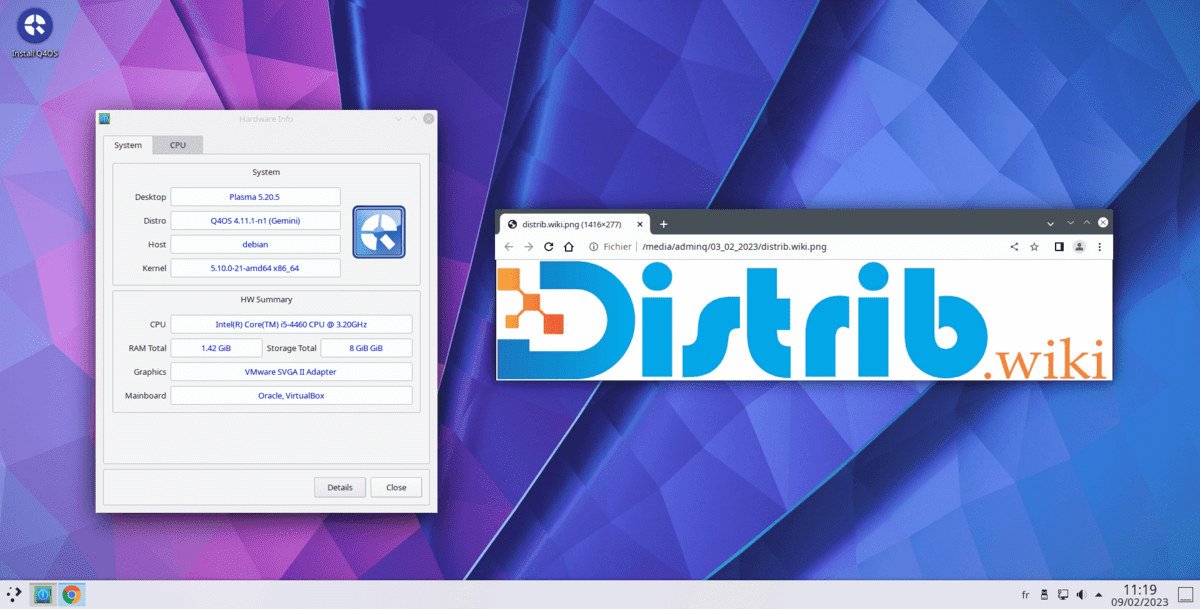
Its two main desktop options are KDE Plasma and Trinity Desktop Environment. Plasma provides a modern, highly configurable interface; Trinity offers a lighter experience derived from the older KDE 3 desktop. They address different priorities.
Typical uses include browsing, office work, email, files, light media tasks, learning Linux and returning an older computer to useful desktop work.
The history of Q4OS
Q4OS appeared in the 2010s with a focus on a lightweight, stable desktop. It chose Debian as its base for the package ecosystem, documentation and maintenance approach.
Trinity, derived from KDE 3.5, was a defining early choice. Its traditional interface and modest resource needs distinguished Q4OS from desktops with heavier graphical requirements.
The project later added Plasma as a more contemporary option. Users could choose between a modern desktop and Trinity’s emphasis on a restrained, conventional interface.
The releases discussed in the French profile are Q4OS 6 Andromeda and the older Q4OS 5 Aquarius. They follow Debian generations. Confirm the support status and available images of each release before choosing one.
Advantages of Q4OS
Trinity is intended for modest resource use and can suit older computers or limited laptops. Actual responsiveness also depends on the applications and websites you use.
The Debian base supplies APT package management, a broad software catalogue and extensive documentation. Users can draw on resources from the wider Debian ecosystem.
The desktop choice is useful: Plasma offers extensive contemporary customisation, while Trinity provides a traditional interface related to older desktop environments.
Application menus, a taskbar, icons and conventional windows may feel familiar to users moving from Windows. This can reduce the amount of interface relearning involved.
Q4OS provides tools for installing applications, configuring the system and customising the environment, reducing the need to perform every initial configuration step manually.
Limitations of Q4OS
Trinity’s appearance can seem dated compared with newer desktops. Its traditional design is an advantage for some users and a drawback for others.
Plasma generally needs more resources than Trinity. On very limited hardware, assess Trinity first; more capable computers may comfortably support Plasma’s additional features.
The community is smaller than those of Ubuntu, Linux Mint, Debian, Fedora and openSUSE. Specific tutorials may be harder to find, although relevant Debian and APT documentation can help.
The emphasis is stability and conventional desktop use rather than the newest visual or technical changes. Fedora, KDE neon, openSUSE Tumbleweed and Arch Linux offer different update and desktop priorities.
Q4OS primarily targets desktops and learning. For production servers or complex business infrastructure, consider systems such as Debian Server, Ubuntu Server or Red Hat Enterprise Linux.
Q4OS editions
The Plasma edition offers a feature-rich, configurable desktop for suitably capable computers and users who want a more contemporary graphical environment.
The Trinity edition uses the KDE 3.5-derived desktop and focuses on modest resource needs and a traditional interface. It is the lighter option to assess for older hardware.
Depending on the release, the project offers live media and install-cd images. Live media allow a trial before installation; installation CDs can suit more limited computers or a smaller initial setup.
Q4OS 6 Andromeda is the newer generation covered in this profile. It uses a newer Debian base, with Plasma and Trinity options according to the available images.
Q4OS 5 Aquarius is the older stable generation discussed here. Existing users or particular compatibility requirements may justify retaining it while supported. For a new installation, check the latest stable release and its hardware requirements.
Conclusion
Q4OS combines a Debian base with two distinct desktop approaches: Plasma for extensive features and Trinity for a lighter, conventional environment.
Its focus is a restrained desktop rather than elaborate visual effects, especially in the Trinity edition. It is an option for exploring Debian-based computing on older or more modest hardware.