
Opens the download page on distrib.wiki.
English edition published on .
KaOS: an independent Linux distribution focused on Qt
KaOS is a free, open-source, independent Linux distribution built from scratch rather than derived from Ubuntu, Debian, Fedora or Arch Linux. It has its own package selection and technical decisions, with a deliberate focus on a coherent Qt-based system.
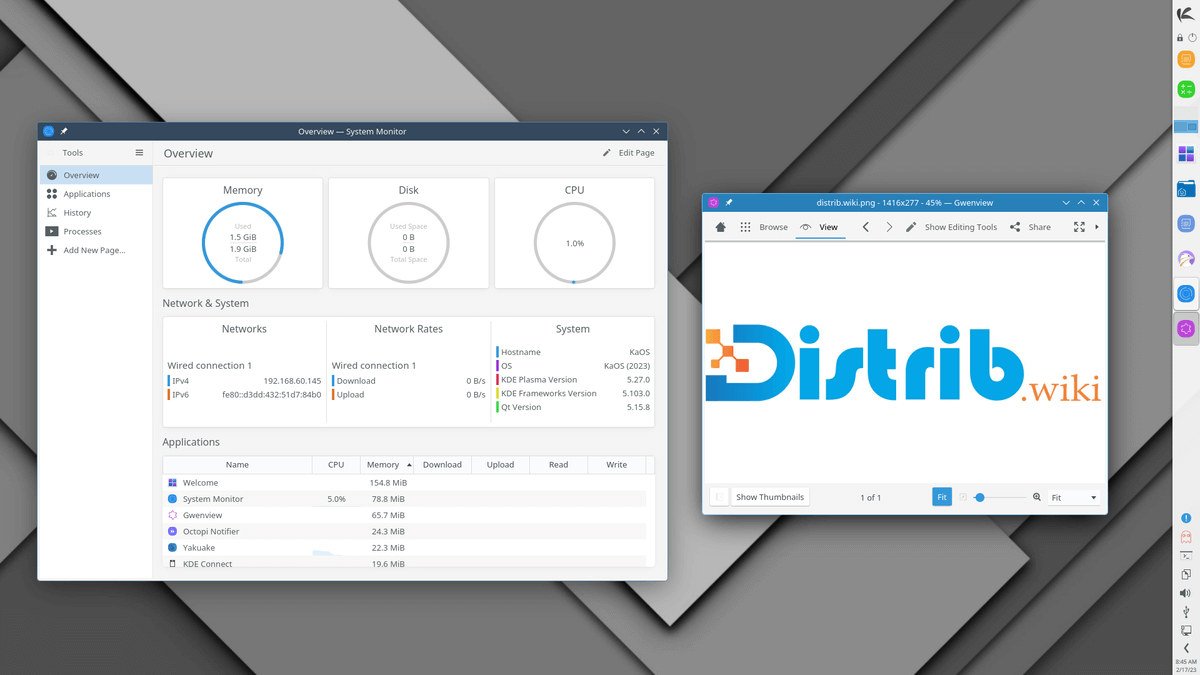
Historically, KaOS was closely associated with KDE Plasma. For many years it concentrated on a recent, integrated KDE desktop, one architecture—x86_64—and one main toolkit, Qt.
The 2026 releases described in this profile changed the default environment to Niri with Noctalia Shell while retaining the Qt focus. KDE Plasma 6 remained available in the repositories for users who preferred it. This represents a change in desktop direction within the project’s focused approach.
The history of KaOS
KaOS appeared in 2013 as an independent rolling-release distribution centred on KDE and Qt. Rather than supporting many desktops, architectures and variants, it deliberately concentrated on a narrow set of technologies.
It builds its own system and repositories. Although it uses pacman, familiar from Arch Linux, it is not an Arch derivative and its packages come from KaOS repositories.
For more than a decade, the project integrated recent Plasma, KDE Frameworks, KDE Gear and Qt versions. It offered a focused KDE experience without the broader scope of a general-purpose distribution.
In 2026, Niri and Noctalia Shell arrived on the official ISO. KaOS 2026.03 reflected this change while keeping Plasma 6 available in the repositories; the emphasis remained a coherent Qt-oriented distribution.
Advantages of KaOS
Its limited technology selection is intended to create a consistent system, reducing unnecessary dependencies and mixtures of desktop environments. It does not attempt to offer every possible configuration.
The rolling-release model updates an installed system continuously without routine full reinstalls. Periodic ISOs provide recent starting points so that new installations need fewer initial updates.
Independence allows KaOS to build its own packages, manage its repositories and make focused technical choices rather than simply follow a parent distribution.
Pacman provides familiar package-management syntax for users with Arch experience, while operating on KaOS’s own repositories. Experienced users can install, update and remove software with this tool.
The combination described here—Niri, Noctalia Shell, Qt and optional Plasma—offers an experience different from more general-purpose desktop distributions.
Limitations of KaOS
The specialised focus excludes many official desktop choices. Users who want GNOME, Xfce, Cinnamon, MATE or LXQt as a main supported option may prefer a broader distribution.
The deliberately limited repositories may not contain every application. Software easily available on Debian, Ubuntu, Fedora or Arch may be absent or require another installation method.
Rolling releases need regular maintenance. Apply updates correctly and follow important project announcements. A supported LTS distribution may better suit a workstation intended to keep the same base for several years.
The move from Plasma to Niri and Noctalia Shell can surprise long-time users. Those wanting Plasma by default can compare KDE neon, Kubuntu, Fedora KDE and openSUSE KDE, or follow KaOS guidance to install Plasma from its repositories.
KaOS targets x86_64 PCs, not old 32-bit computers, a wide range of server architectures or embedded systems. Other distributions, such as Debian, Fedora, openSUSE or antiX, cover different hardware requirements.
KaOS releases and features
KaOS is a rolling release rather than a succession of conventional major versions. Images such as 2026.03 are installation snapshots. Existing users normally update the complete system instead of reinstalling for each ISO.
The French profile describes the 2026.03 ISO: Qt and KDE applications, no GTK applications by default, and Niri with Noctalia Shell as the official image’s environment. Check the project’s download page for a newer snapshot.
Plasma 6 remained available in the repositories alongside the changed ISO default. Users who prefer it should follow the project’s installation recommendations.
Pacman manages installation, updates and removal using the project’s selected repositories. The emphasis is a curated collection rather than the largest possible package catalogue.
For a fresh installation, use the latest official ISO suitable for your hardware to reduce the amount of updating required immediately after installation.
Conclusion
KaOS is an independent distribution for users interested in Qt, coherent technical choices and rolling updates. The Niri and Noctalia transition illustrates how the project can change while retaining its focused identity.
It may not suit newcomers seeking a broad application catalogue or many official desktop choices. For users interested in Qt, Plasma and alternative Wayland desktops, it offers a distinctive approach.