

Opens the download page on distrib.wiki.
English edition published on .
Frugalware: an independent Linux distribution
Frugalware Linux was an independent GNU/Linux distribution historically aimed at intermediate users comfortable with the command line. It sought a simple, responsive, uncluttered and relatively modern system influenced by Slackware. Rather than targeting complete beginners, it served users who wanted to understand and control their computer without excessive complexity.
Its approach combined Slackware-inspired restraint and Unix-like organisation with more automated package management. Frugalware used pacman-g2, a modified package manager derived from pacman in the Arch ecosystem.
Frugalware could serve as a desktop, development environment or general-purpose Linux system. It offered binary packages, administration tools and graphical environments for users willing to manage their own computer. However, the project announced that it would discontinue development at the end of 2025.
History of Frugalware
Frugalware was created by Miklós Vajna in the mid-2000s to provide a straightforward independent distribution for intermediate users. Early releases were influenced by Slackware, but the project developed its own tools, repositories and identity.
Its pacman-g2 package manager handled installation, removal and updates with automatic dependency resolution. For some users, this was more convenient than Slackware while retaining a relatively direct system design.
Over the years, Frugalware produced stable releases and development branches supported by a community with a substantial European presence. Active periods brought regular updates, desktops including KDE, GNOME, Xfce, MATE and Fluxbox, and documentation aimed at experienced users.
On 3 October 2025, the team officially announced that Frugalware would be discontinued at the end of that year and archived. This marked the end of a distinctive independent Linux project.
Historical advantages of Frugalware
Simplicity was an important goal. Frugalware tried to remain clear and understandable without accumulating unnecessary layers. It suited users wanting a direct Linux system that was easier to maintain than an entirely manual setup.
pacman-g2 was another attraction. It provided command-line software management with a concise syntax and dependency handling, appealing to people who liked pacman’s approach but wanted a distribution separate from Arch.
Its independence also mattered. Frugalware was not simply an Ubuntu, Debian, Fedora or Arch variant: it maintained its own base, packages and technical decisions. It offered a way to explore Linux outside the largest distribution families.
The system occupied an intermediate position: less automated than consumer-oriented distributions but less demanding than assembling everything manually. It offered opportunities to learn package management, the terminal and Linux administration.
Frugalware also demonstrated how a small team could maintain a coherent independent distribution over many years. Its history remains worth preserving even though the project has ended.
Limitations of Frugalware
Discontinuation is now the overriding concern. The project announced an end to development at the end of 2025. Frugalware should therefore not be treated as a recommended choice for a new main installation, especially on an internet-connected computer.
A discontinued distribution cannot be relied upon for continued package maintenance and security fixes. Using an unsupported system for daily work, professional services or servers can create significant risks. A maintained distribution such as Debian, Fedora, openSUSE, Arch Linux, Slackware, MX Linux or Linux Mint is a more appropriate starting point.
Frugalware had a smaller community than major Linux distributions. Specific documentation, recent tutorials and solutions could be harder to find. Project archival makes this limitation more significant.
It was not designed for complete beginners. Its intended users could work in a terminal and understand configuration choices. People seeking a straightforward initial desktop might instead consider Ubuntu, Linux Mint, Zorin OS or Fedora.
Its software ecosystem was also smaller than those of Debian, Ubuntu, Fedora and Arch. Some newer, specialised or popular applications could be harder to obtain or maintain than on more widely used distributions.
Frugalware releases and technical features
Frugalware had multiple stable releases with project-specific codenames and schedules. Its development branch, called current, served users who wanted newer packages and could help test them.
Packages were managed through pacman-g2 and generally used the .fpm extension. FrugalBuild files also allowed structured package builds from source.
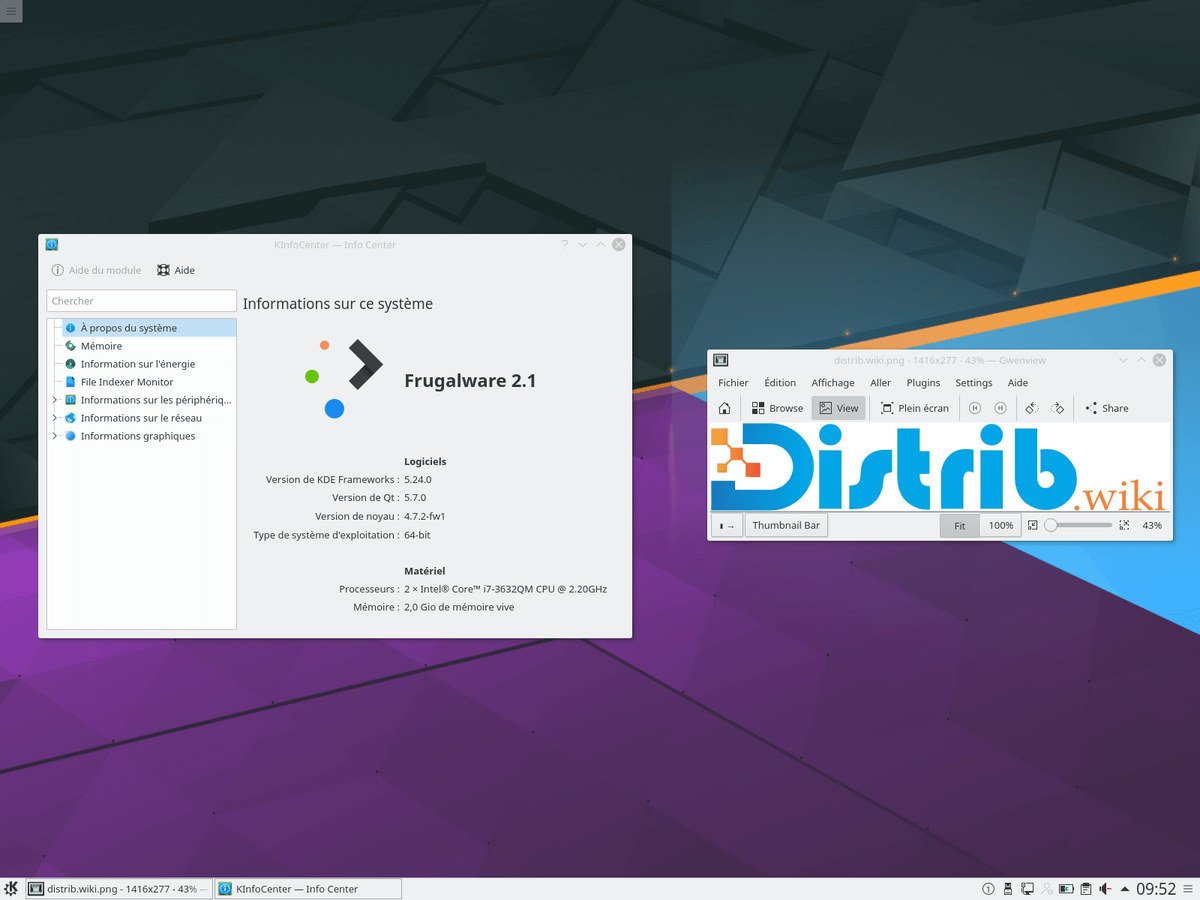
Available desktops varied by release and packages. Project screenshots and archives show environments including KDE, Xfce, MATE, Fluxbox and i3. Frugalware was not restricted to one desktop, though users were expected to customise their own setup.
Historically supported architectures included i686 and x86_64, with other ports or experiments at different times. More recent users generally looked for x86_64 installation images where available.
Following the October 2025 announcement, Frugalware is chiefly relevant for archives, historical research, isolated testing or nostalgia. A modern workstation should use a maintained distribution.
Overall assessment
Frugalware contributed a simple, intermediate-user approach influenced by Slackware and paired with automated package management through pacman-g2. It aimed to provide an uncluttered, controllable Linux system.
The project’s announced closure at the end of 2025 must now accompany any introduction. Its history, philosophy and technical choices remain interesting, but it is not recommended for a new main installation. Users attracted to its approach can compare maintained projects such as Slackware, Arch Linux, Void Linux and Debian.